
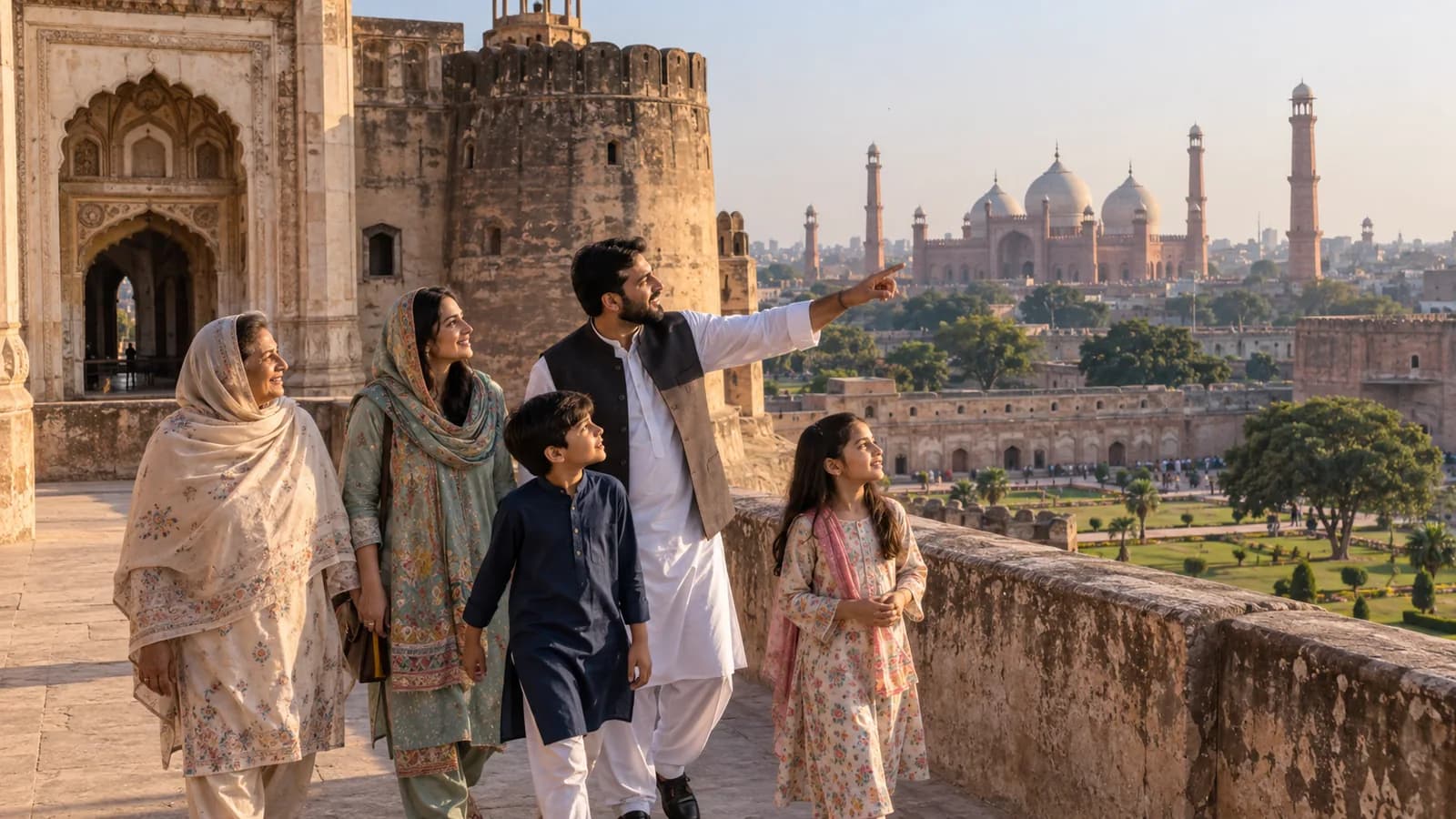
Lahore travel guide
Top Places to Visit in Lahore with Family
A practical family guide to Lahore’s strongest heritage sights, parks and cultural experiences, with realistic visit lengths, sensible combinations and advice for children, elders and drivers.
Published 2026-09-25 · 10 min read
How to plan a Lahore sightseeing day with family
Lahore’s best-known attractions do not all belong in one rushed itinerary. The Lahore Fort, Badshahi Mosque and Greater Iqbal Park form the most practical heritage cluster and can fill a comfortable half day. Shalimar Gardens, Lahore Museum and Jilani Park sit in other parts of the city, while Wagah Border works best as a separate outing. Families usually have a better experience when they choose one main cluster, allow time for meals and prayer breaks, and avoid crossing Lahore repeatedly in peak traffic.
The time estimates below are planning ranges rather than official visit limits. Weather, security arrangements, prayer times, school holidays, public events and restoration work can change access. Confirm current opening days, entry arrangements and any ceremony schedule with the responsible authority shortly before leaving. Carry drinking water, sun protection and comfortable footwear; heritage sites involve more walking than their map pins suggest.
1. Lahore Fort: the best starting point for Mughal Lahore
Lahore Fort, or Shahi Qila, is a large historic complex beside the Walled City. Its surviving buildings include Mughal palaces, audience halls, gateways and decorative spaces added by successive rulers. It shares UNESCO World Heritage status with Shalimar Gardens, and its scale helps children and teenagers understand that this was a working royal citadel rather than a single monument.
Allow roughly two to three hours if the family wants to walk through the main courtyards and see major highlights without hurrying. A morning visit is usually easier in warm weather; late afternoon can be pleasant when daylight and access allow. The fort has long walking stretches, steps and uneven surfaces, so families with grandparents, toddlers or strollers should keep the route selective and take breaks.
The fort is in the Badshahi Mosque and Greater Iqbal Park area. Roads and parking around the heritage zone can become congested, especially on weekends and event days. A practical arrangement is to use one drop-off point, cover the Fort and Mosque on foot, and agree on a clear pickup location with the driver instead of trying to move the car between nearby gates.
2. Badshahi Mosque: architecture, worship and family photographs
Badshahi Mosque faces the Alamgiri Gate of Lahore Fort and is one of the city’s defining Mughal landmarks. Its vast courtyard, red sandstone exterior and views toward the Fort make it memorable even for family members who are not keen museum visitors. Because it remains a mosque, the visit should be approached as both a heritage experience and time in an active place of worship.
Most families can spend about 45 to 75 minutes here, longer if they pause in the courtyard or combine the stop with nearby Huzoori Bagh. Morning or later afternoon light is comfortable for walking and photographs, but prayer activity takes priority. Dress modestly, carry a scarf if needed, supervise young children, and expect to remove footwear in designated areas. Avoid planning a hurried tourist visit across congregational prayer time; local instructions and restricted areas should always be respected.
3. Minar-e-Pakistan and Greater Iqbal Park: space after the monuments
Minar-e-Pakistan stands in Greater Iqbal Park, marking the place associated with the Lahore Resolution of 1940. The wider park gives families open space after the more concentrated Fort and Mosque visit, and the setting helps connect Mughal Lahore with the story of the Pakistan Movement. It is particularly useful when children need a less formal stop between historic buildings and dinner.
Set aside around one to one-and-a-half hours for a relaxed walk and exterior views; allow more if a museum or programmed attraction is part of the day. Late afternoon and early evening are often more comfortable than the middle of a hot day. Large public gatherings and national-day events can substantially change traffic, access and pickup points, so check the day’s local situation before relying on the usual route.
4. Shalimar Gardens: a quieter Mughal landscape
Shalimar Gardens is the garden half of Lahore’s UNESCO World Heritage property. Built in the Shah Jahan period, it is arranged across terraces with pavilions, formal paths, water channels and large basins. Families who find the Fort too dense may appreciate the open layout, while older children can compare Mughal garden planning with the Fort’s palaces and defensive walls.
A visit of about one to one-and-a-half hours suits most families. Morning or late afternoon is preferable for shade and photographs, depending on the season. The gardens are in the Baghbanpura area and should be treated as a separate drive from the Walled City cluster rather than an extra stop squeezed between the Fort and Mosque. Water features or individual areas may be affected by maintenance, and current access should be checked before travel.
5. Lahore Museum: the strongest indoor history stop
Lahore Museum is on Shahrah-e-Quaid-e-Azam, commonly called The Mall. Its collections span archaeology, Gandharan sculpture, Islamic art, manuscripts, miniature painting, Sikh history, the Pakistan Movement and other parts of the region’s cultural history. It is a good choice for school-age children, visiting relatives interested in history, or any day when heat, rain or air quality makes a long outdoor plan uncomfortable.
Allow around one-and-a-half to two hours for a selective family visit rather than trying to cover every gallery. Ask each child to choose a few objects or galleries that interest them; this is usually more engaging than moving room by room. Daytime is the natural fit. The museum publishes visitor information through its official site, but opening days, gallery access and ticket arrangements can change, so verify them before setting out. Mall Road traffic and curb access can be busy; agree on a pickup point rather than asking the driver to wait directly at the entrance.
6. Jilani Park: an easy family break in central Lahore
Jilani Park, still widely known as Race Course Park, is a landscaped public park on Jail Road. It is less about ticking off a landmark and more about giving children room to walk while adults take a break from museums, bazaars and traffic. It can work well after Lahore Museum or before an early dinner in Gulberg, depending on where the family is staying.
Plan roughly one to one-and-a-half hours. Early morning and the period before sunset are generally more comfortable than midday, particularly in summer. Seasonal flower shows and public events can make the park much busier and affect nearby parking. For a multi-generation group, use the most convenient gate for drop-off and confirm the same gate for pickup; meeting at ‘Jilani Park’ without naming an entrance can cause unnecessary walking.
7. Wagah Border: a separate, high-energy family outing
The flag-lowering ceremony at the Pakistan–India border is a patriotic, crowded and energetic experience led on the Pakistan side by Punjab Rangers. Families often enjoy the marching, music and audience participation, but it is very different from a quiet monument visit. Loud sound, dense crowds, security checks and waiting may be tiring for very young children, elderly relatives or anyone sensitive to noise.
Treat Wagah as a three-to-four-hour outing including the drive, arrival buffer, security and return journey. The ceremony is associated with late afternoon, but the exact reporting and start time changes with season and official arrangements. Confirm it close to the visit and arrive earlier than the announced ceremony time. Carry identification, keep bags simple, follow security instructions and arrange a precise post-event meeting point with the driver because crowds and vehicle restrictions can complicate pickup.
Where to add family food or shopping
Fort Road Food Street is the natural meal stop after the Fort and Badshahi Mosque because it keeps the family in the same heritage area and offers views back toward the monuments. It is usually better as the end of the Walled City plan than as a reason to move the car mid-visit. Restaurant access, rooftop stairs, waiting times and menu suitability vary, so families with elders or small children should choose the venue rather than assuming every rooftop will be easy to reach.
For broader shopping and restaurant choice, Liberty Market and the Gulberg area are more convenient to pair with Jilani Park than with the Walled City. Anarkali offers a more traditional bazaar experience near The Mall, but it involves crowds and considerable walking. Keep shopping optional: adding a bazaar after several hours at monuments can turn a good family day into an exhausting one.
Three sensible ways to combine the places
For a heritage half day, start at Lahore Fort, continue on foot to Badshahi Mosque, then use Greater Iqbal Park as the open-air final stop before an early meal at Fort Road. This is the strongest plan for a first family visit because the main sights sit in one area and the car can stay out of the route until pickup.
For a lighter culture day, combine Lahore Museum with Jilani Park and a meal in Gulberg or Liberty. For a Mughal architecture day, visit the Fort cluster and Shalimar Gardens only if the family is comfortable with the additional drive and walking. Keep Wagah Border on its own afternoon. Trying to cover the Fort, Museum, Shalimar Gardens and Wagah in one day produces more time in traffic than meaningful time at the places themselves.
If the family is arriving by air, build in rest before sightseeing rather than going directly from the terminal to the Walled City with luggage. Visitors coming from another city should also separate a long road journey from a full monument day where possible. A reserved driver can simplify drop-offs and pickups, but the itinerary still needs realistic buffers for Lahore traffic and family breaks.