
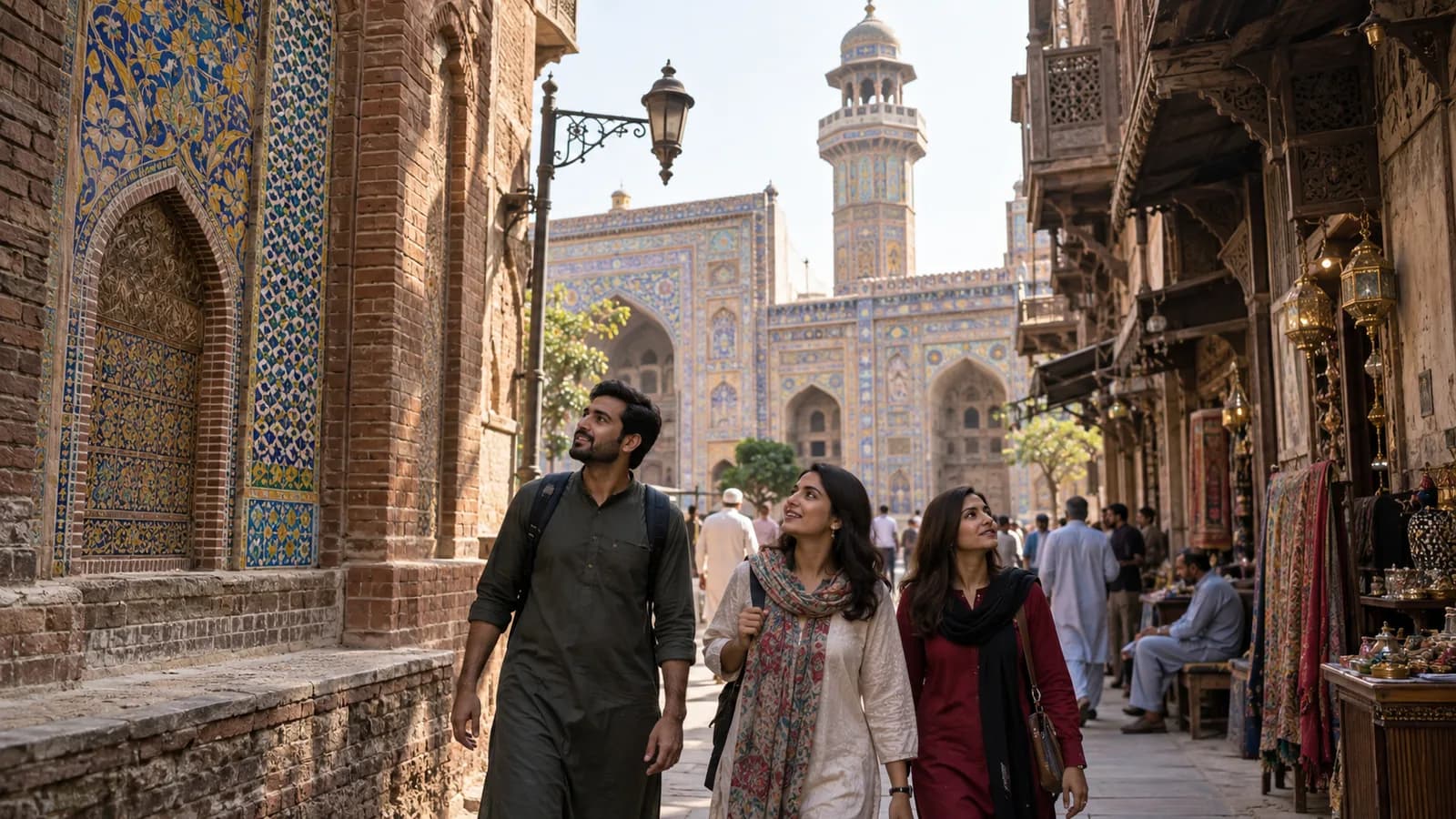
Lahore travel guide
Lahore Travel Guide for First-Time Visitors
A grounded introduction to Lahore for first-time visitors: where to stay, how to group the major sights, what local traffic and weather change, and how to arrive prepared.
Published 2026-09-26 · 11 min read
Start by understanding Lahore’s scale
Lahore is not a compact heritage town. The Walled City and Fort district hold many of its best-known monuments, but the airport and DHA lie farther east, Gulberg is a modern dining and commercial centre, The Mall contains major cultural institutions, and Shalimar Gardens and Wagah Border sit on different outward routes. A first visit works best when each day is built around one part of the city.
Use travel times shown on a map as a starting point rather than a promise. School runs, office peaks, Friday prayer, rain, public events, road works and security arrangements can all change the same journey. Keep one flexible stop per day and avoid putting a flight, train or intercity departure immediately after sightseeing in Old Lahore.
Choose the season—and check the day’s conditions
Lahore’s outdoor heritage visits are generally easier in the cooler part of the year, while late spring and summer require earlier starts, shade breaks and less walking at midday. The monsoon can bring intense rain and local waterlogging, so keep indoor alternatives and extra road time. Seasonal conditions vary from year to year; check a current forecast rather than relying on a fixed monthly rule.
Smog is a serious planning issue in late autumn and winter. Punjab’s disaster-management guidance notes that Lahore and surrounding areas can experience dense smog, particularly around November and December, with effects on breathing, visibility and even flights. Check current official air-quality and weather advice, reduce strenuous outdoor time when conditions are poor, and take particular care with children, older adults and anyone with respiratory illness.
Choose where to stay based on the trip, not one landmark
Gulberg is a practical first-visit base for restaurants, shopping and access to several central districts. The Mall, Jail Road and nearby central areas suit travellers focused on museums, colonial-era Lahore and shorter movement toward the Walled City. DHA and Cantt can be convenient for the airport, business visits and eastern Lahore, but a heritage-heavy itinerary will involve longer drives.
Staying close to the Walled City can be atmospheric, but vehicle access, luggage handling, noise and walking conditions vary street by street. Confirm the exact pickup point and parking arrangement with the accommodation before arrival. Families should also check lift access, connecting rooms and generator or backup-power arrangements rather than choosing only by distance on a map.
Arriving by air, rail or road
Allama Iqbal International Airport serves Lahore and the surrounding region. For an airport arrival, keep the flight number and terminal details with the driver, allow for baggage and security delays, and confirm a phone-based meeting plan before landing. Do not schedule a full Fort visit directly after an overnight flight; check in, leave the luggage securely and rest first.
Lahore Railway Station is a major junction, while intercity coaches arrive at terminals in different parts of the city. Confirm the exact terminal name rather than saying only ‘the bus stand’. Travellers arriving by motorway should also tell the driver the final neighbourhood, because the best entry route depends on whether the destination is Gulberg, DHA, central Lahore or the Walled City.
Getting around Lahore without wasting the day
Ride-hailing and rickshaws are useful for simple point-to-point trips, but a full heritage day involves uncertain pickup zones and several hours of waiting between stops. A car with a driver is often easier for families, luggage, elders or a multi-stop itinerary. Agree on whether parking and waiting are included, share the route before departure, and name a precise pickup landmark at large parks and heritage sites.
Public transport can be useful when the route matches it. The Punjab Masstransit Authority operates the Lahore Metrobus and Orange Line; official station information shows Orange Line stops serving areas including Anarkali, GPO, Railway Station, Baghbanpura and Shalamar Garden. It is not a door-to-door sightseeing system, so factor in the walk, heat, crowds and the final connection. Verify current operating information and fares on the authority’s site because they can change.
The essential first sightseeing cluster: Fort, Mosque and Minar-e-Pakistan
For most first-time visitors, the strongest starting point is Lahore Fort followed on foot by Badshahi Mosque, Hazuri Bagh and the Greater Iqbal Park area. The Fort and Shalimar Gardens form Lahore’s UNESCO World Heritage property, while Badshahi Mosque remains an active place of worship opposite the Fort. Together, this cluster introduces Mughal architecture, Sikh-period Lahore and the Pakistan Movement without repeated cross-city driving.
Give the cluster at least half a day. The Fort alone can take two to three hours, and the stone surfaces, steps and open courtyards are more tiring than the map suggests. Dress modestly for the mosque, expect footwear arrangements, respect prayer activity and follow current security instructions. Fort Road can be a convenient meal finish, but rooftop access varies and should be checked for elders or small children.
Build later days around separate Lahore clusters
Pair Lahore Museum on The Mall with Anarkali or Jilani Park for a central culture day. The museum’s official collection spans archaeology, Gandharan art, manuscripts, miniature painting, Islamic art, Sikh history and the Pakistan Movement. Verify its current opening day before travel and choose a few galleries rather than treating the building as a quick photo stop.
Pair Shalimar Gardens with another north-Lahore stop only if the group is comfortable with additional road time. Use a separate morning for the Royal Trail from Delhi Gate toward Wazir Khan Mosque; the Punjab Walled City Authority identifies Wazir Khan Mosque as a short walk inside Delhi Gate and publishes guided heritage programmes. Keep Wagah Border as its own afternoon because the drive, security checks, crowd and seasonally changing ceremony arrangements require a generous buffer.
Approach food and shopping by area
Old Lahore is the place for a dense bazaar atmosphere, traditional breakfast culture and heritage views, but the streets can be crowded and vehicle access limited. Gulberg and Liberty offer a broader range of restaurants and shops with easier modern-city logistics. Anarkali is convenient with Lahore Museum, while DHA works better with airport-side or eastern Lahore plans.
Food hygiene, spice level, seating and card acceptance vary. Families may want bottled or safely filtered water, a simple meal option for children and some cash for smaller vendors. Do not plan a heavy traditional breakfast, a long outdoor heritage walk and a large dinner without rest in between—Lahore hospitality is easier to enjoy when meals are part of the schedule rather than additions to it.
Local etiquette and practical safety
Urdu and Punjabi are widely spoken, and English is common in hotels and many visitor-facing settings. Ask before photographing people, especially inside bazaars, workshops and religious places. Dress modestly at mosques and shrines, keep shoes and head-covering expectations in mind, and let worship take priority over photography.
Keep identification available where security checks are likely, but do not carry unnecessary valuables through crowded markets. Use normal city awareness with phones and bags, agree on meeting points if the group separates, and retain the accommodation address in both English and Urdu where possible. For emergency, health, traffic or security advice, rely on current official guidance rather than an old travel post.
How many days should a first Lahore trip have?
One full day is enough for the Fort, Badshahi Mosque, one nearby park or museum and a meal. Two days allow a second cluster such as Lahore Museum and central Lahore, or Shalimar Gardens and the Royal Trail. Three days make room for Wagah Border, slower food experiences, shopping and weather-related changes without sacrificing the main sights.
Build the first day around the reason for the trip, then leave the final half-day flexible. A family visit, a wedding, a business meeting or an airport connection can use more energy and road time than expected. Lahore rewards slower visits: seeing fewer places with enough time to walk, eat and talk usually gives a more truthful sense of the city than collecting distant landmarks in one vehicle-heavy day.